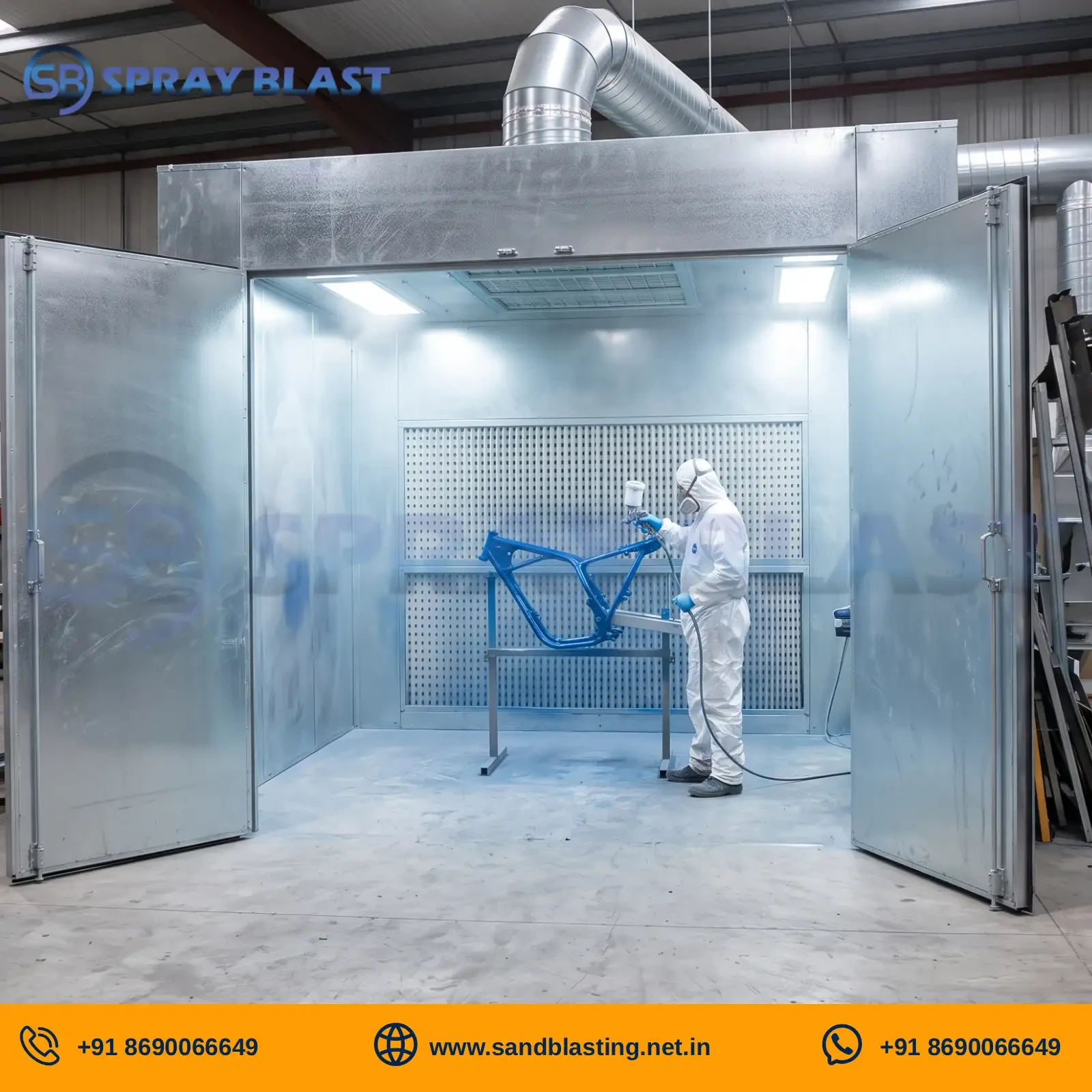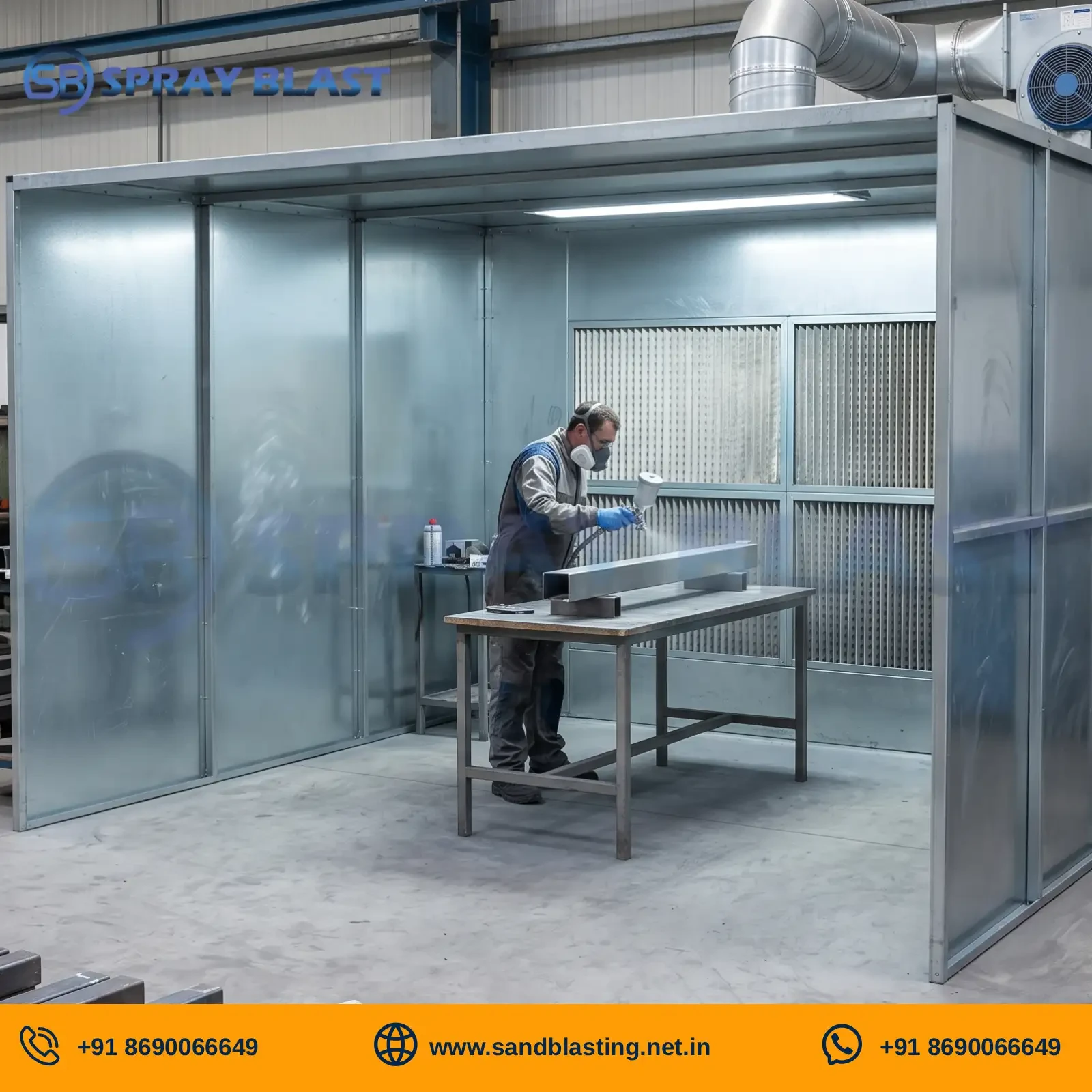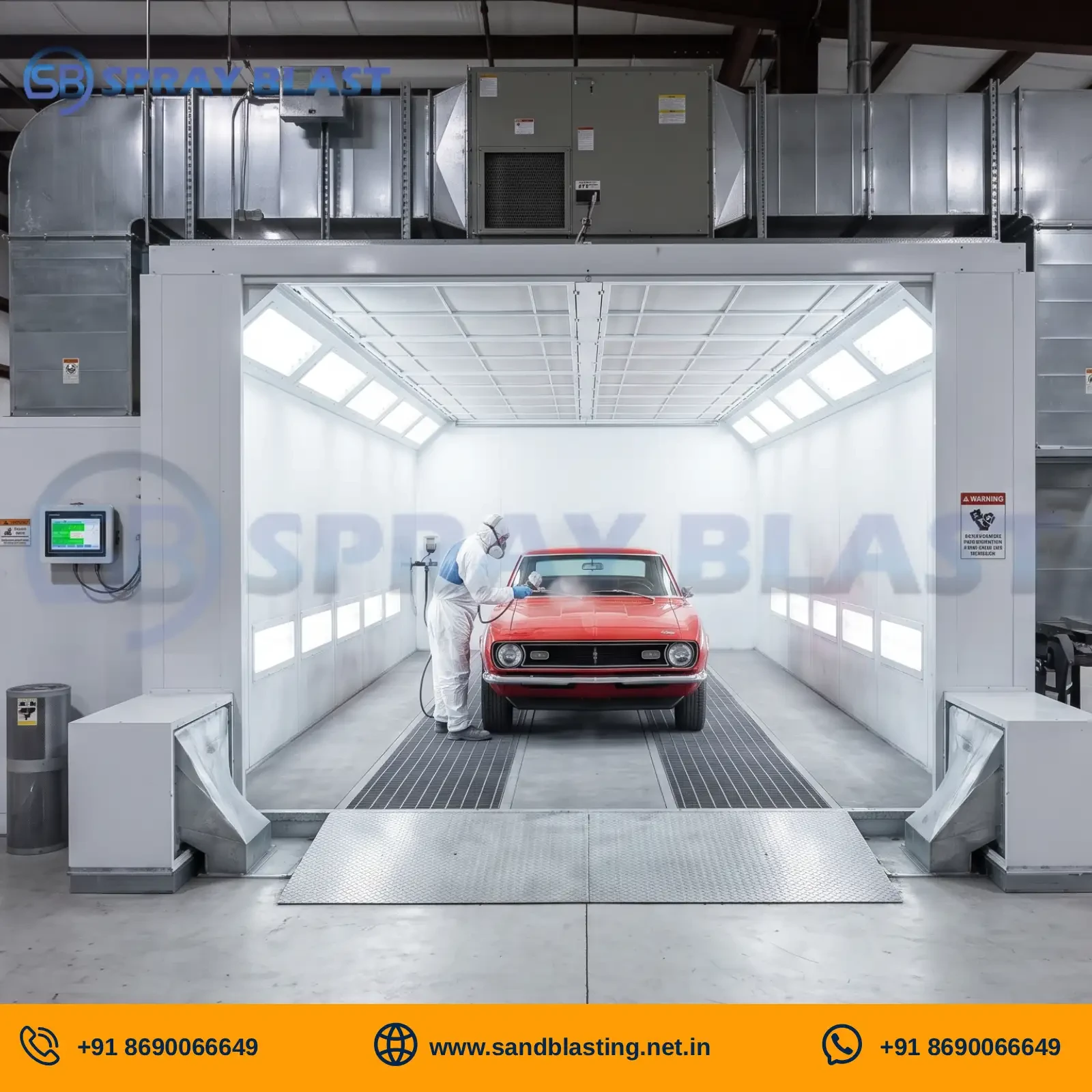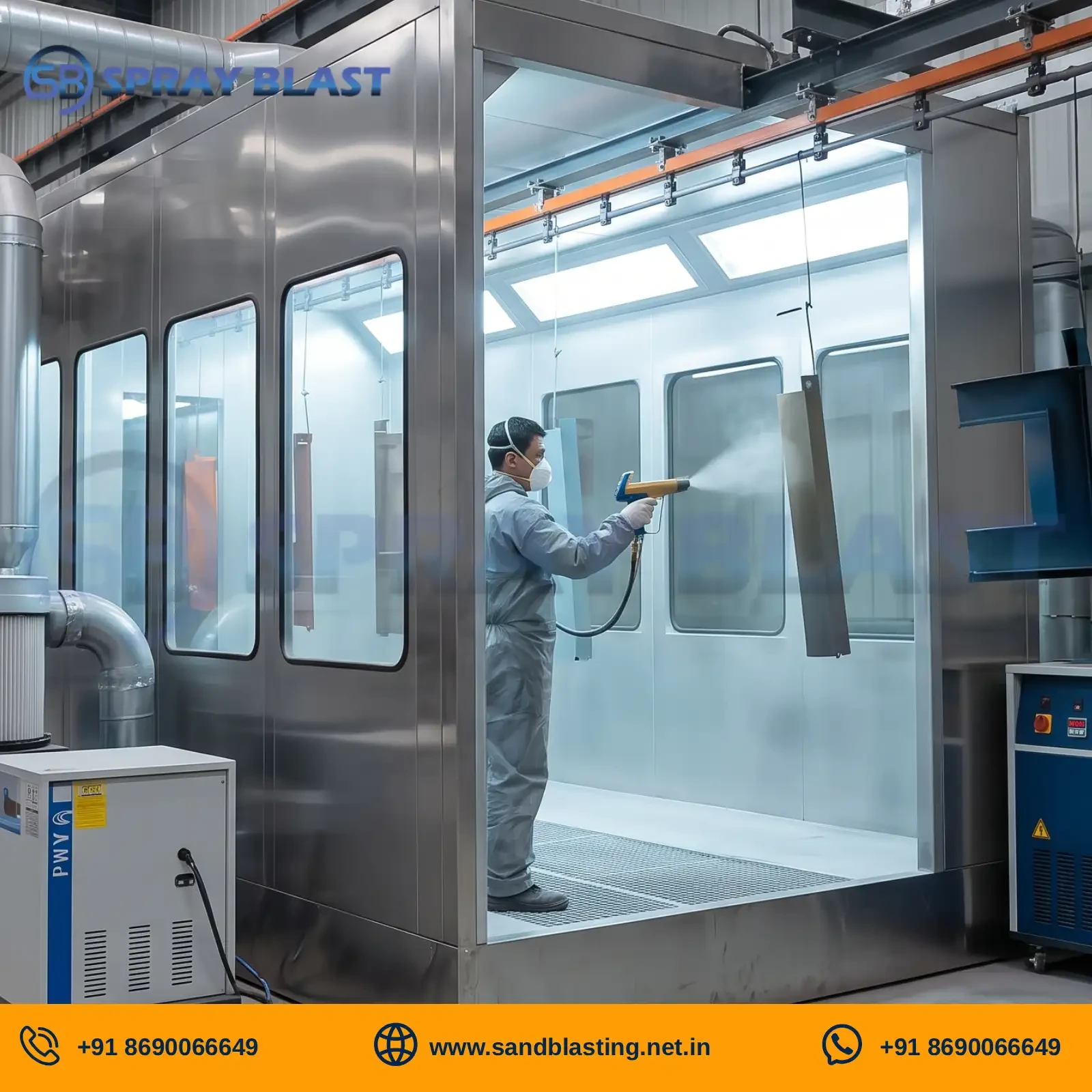
Spray Painting
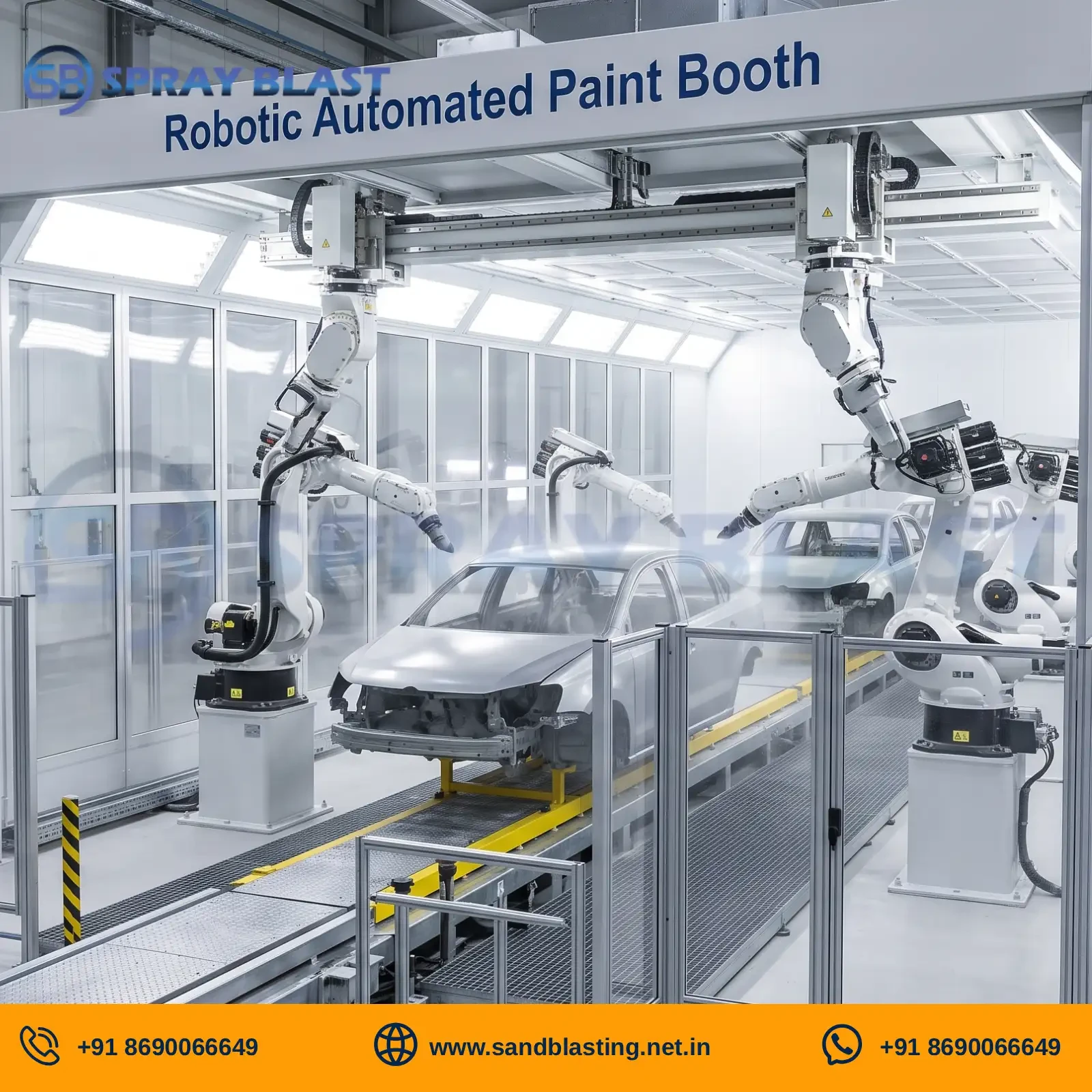
Robotic Automated Paint Booth provides a contained zone for primer and finish coats.
EnquirePaint Booth
Boost efficiency and precision with our Industry 4.0 robotic paint booth. Our automated spray systems deliver consistent, high-quality coatings for complex industrial applications. Request a quote.
Review the key product specifications used for quotation and application planning.
Boost efficiency and precision with our Industry 4.0 robotic paint booth. Our automated spray systems deliver consistent, high-quality coatings for complex industrial applications. Request a quote.
Robotic Automated Paint Booth loads the robot recipe for part size, guns, and cycle time.
Parts are clamped or conveyed into the programmed spray envelope.
The robot applies paint or powder with repeatable gun distance and overlap.
Booth airflow and filters contain mist while interlocks keep the cell safe.
Coated work leaves for drying, curing, or the next process station.
Film build and coverage are checked against the programmed standard.
Get ready for the future of industrial finishes by using our cutting-edge robotic/automated paint booth, which represents an important tool in the Industry 4.0 era and technology that totally redefines the painting and finishing industries. Main features; six joints robotic arm, cleverly planned movement and tasks of the robots through the path programming system, real-time quality monitoring; all the operations are done automatically. This single system can replace a whole finishing line while ensuring top-quality results consistently.
By running a continuous production line with our robotic/automated paint booth, you are going to get a tool that is equally effective and efficient. You will get a great piece of equipment with an outstanding impact on your productivity and environment-friendly aspects, the system helping reduce overspray, waste, and VOC emissions without touching labor efficiency and even lessening them to some extent. For us, the most important thing is the quality of the end product, and working with new technologies, we want to ensure you a competitive sales advantage, allowing you to operate at top levels. Your satisfaction ensures our success! Hurry with your purchase decision and lease the highest quality automated paint booth options to meet your needs!
Our APEX-Series robotic paint booth systems are engineered for precision, durability, and seamless integration into modern manufacturing workflows. The following specifications detail the core technical attributes of our standard models, with custom configurations available upon request.
| Parameter | Specification |
|---|---|
| Booth Type | Fully Automated Robotic Paint Booth |
| Automation Level | Robotic (Programmable PLC / CNC Controlled) |
| Robot Type | 4-Axis / 6-Axis Industrial Painting Robot |
| Working Envelope | Customizable (Based on component size & layout) |
| Payload Capacity | 5 – 20 kg (depending on robot model) |
| Repeatability | ±0.02 mm to ±0.1 mm |
| Painting System | Air Spray / Airless / Electrostatic Spray |
| No. of Spray Guns | 1 to 4 (Customizable) |
| Booth Construction | Powder-coated MS / Galvanized Steel Panels |
| Airflow Design | Crossdraft / Downdraft / Side Draft |
| Filtration System | Multi-stage (Pre-filter + Paint Arrestor + HEPA Optional) |
| Air Velocity | 0.3 – 0.5 m/s (adjustable) |
| Lighting | LED Flameproof Lighting (800–1000 Lux) |
| Control System | PLC + HMI Touch Panel |
| Programming | Teach Pendant / Offline Programming |
| Conveyor System | Overhead / Roller / Power & Free Conveyor (Optional) |
| Drying System | Integrated Baking Oven / IR Heater (Optional) |
| Dust Collection | Wet Scrubber / Dry Type Dust Collector |
| Power Supply | 380V – 440V, 3 Phase, 50 Hz |
| Safety Features | Emergency Stop, Interlocks, Flameproof Panels, Fire Suppression System |
Custom dimensions available.
A robotic paint booth functions on the principle of precision automation. It brings together advanced robotics, environmental controls, and intelligent software to offer flawless, repeatable coatings. What the system does is change the manual spraying process into a highly efficient, data-driven production cycle. It reduces human intervention to the minimum and increases the quality to the maximum level. The main process is that of a carefully programmed sequence for industrial-grade finishing operations.
Our robotic painting systems are engineered from premium, industrial-grade components designed for maximum uptime, precision, and safety. Each element is integrated to create a seamless, intelligent finishing solution.
| Component Name | Description | Function | Material | Typical Dimensions | Typical Weight | Color |
|---|---|---|---|---|---|---|
| Pressurized Downdraft Enclosure | A fully enclosed, modular structure with interlocking insulated panels and integrated personnel and equipment access doors. | Contains paint overspray, controls airflow for a Class A finish, and ensures operator safety. Forms the main body of the robotic/automated paint booth. | 18-gauge galvanized steel panels with 4" rockwool insulation. | Customizable (e.g., 8m L x 5m W x 4m H) | 4500 kg+ (Varies) | White (Interior), Gray (Exterior) |
| 6-Axis Painting Robot | A high-precision, explosion-proof (ATEX/FM certified) robotic arm designed for complex spray patterns and consistent application. | Automates the paint application process, ensuring uniform coating thickness, repeatability, and access to intricate geometries. | Cast aluminum alloy arm, high-tensile steel base. | Reach: 1.8m - 2.6m | ~250 kg | Manufacturer Specific (e.g., Orange, Yellow) |
| Integrated PLC Control System | The central nervous system of the automated spray booth features a PLC and a high-resolution touchscreen Human-Machine Interface (HMI). | Manages all system operations, including robot path programming, conveyor speed, ventilation, and safety interlocks. Provides real-time diagnostics. | NEMA 12/IP54 rated steel enclosure. | 1.2m W x 2.0m H x 0.6m D | ~300 kg | Industrial Gray (RAL 7035) |
| AI Vision & Part Recognition | An Industry 4.0 system of 3D cameras and laser scanners integrated with machine learning software for intelligent part identification. | Identifies parts on the conveyor, automatically selects the correct paint program, and adjusts robot paths in real-time for product variability. | Anodized aluminum camera housings, steel mounting brackets. | Camera: 15cm x 10cm x 8cm | ~5 kg (per camera) | Black / Silver |
| Air Make-Up Unit (AMU) | A comprehensive air handling system that conditions, filters, and pressurizes the booth air, coupled with a high-efficiency exhaust stack with VFDs. | Creates a clean, temperature-controlled downdraft airflow to carry overspray away from the part and through filtration, ensuring a flawless finish. | G90 Galvanized Steel housing, aluminum fans. | Varies by CFM (e.g., 4m L x 2.5m W x 2.5m H) | ~1800 kg | Galvanized Silver |
| Automated Paint Kitchen | A precision fluid dosing and delivery system comprising pumps, fluid regulators, color change valves, and atomizers (e.g., electrostatic bells). | Precisely mixes, meters, and delivers single or multi-component coatings to the robot's atomizer, ensuring accurate ratios and minimizing paint waste. | Stainless steel wetted parts, Teflon-lined hoses. | Modular rack (e.g., 2m W x 2m H x 1m D) | ~400 kg | Stainless Steel / Blue |
| Overhead or Floor Conveyor | An automated material handling system, such as a power-and-free or friction drive conveyor, is integrated with the booth's control logic. | Transports parts into, through, and out of the robotic/automated paint booth at a controlled speed for consistent application and curing. | Powder-coated structural steel. | System-dependent | System-dependent | Safety Yellow / Gray |
The automated painting booth we have developed has been created with an eye to providing a specialized solution, rather than a general solution for all needs. In terms of purchasing this product, decision-makers are not interested in merely the initial investment, but also in the long-term cost-effectiveness, regulatory compliance, and consistent performance of our equipment.
Within such an environment, in which there is no room for mistakes, the robotic paint booth offers the required process control for critical components.
In the fast-paced and demanding industry of automobile manufacturing, our robotized paint booth serves as the foundation for an efficient production line process.
For equipment designed to function in extreme conditions, there is no choice but to use equally resilient protective layers. Our robotic paint booth provides such coating to prolong the machine's operational life.
The versatility of our state-of-the-art coating booth ensures seamless adjustments even when manufacturing a broad array of items for job shops.
Buying a robotic/automated paint booth is a big investment. It will affect the quality of production, efficiency of operations, and profitability. To make the right buying decision and to get the most out of your investment, we suggest these steps for our B2B clients:
The choice of an appropriate painting system will be a highly significant investment that will affect the efficiency of production and the quality of the finish, as well as the overall running expenses. Though manual painting can appear quite cheap at first glance, further consideration will help one understand why automated systems represent such a good strategic investment. The following analysis will compare our robot painting booth with alternative solutions.
| Feature / Aspect | Robotic / Automated Paint Booth (Our Solution) | Industrial Paint Booth | Semi-Automated System (Reciprocators) |
|---|---|---|---|
| Initial Investment | High | Low | Medium |
| Operating Cost | Lowest. Drastically reduced labor, minimal material waste (up to 30% savings), and lower rework rates. | Highest. Dependent on skilled labor wages, benefits, training, and high material overspray/waste. | Medium. Reduces some labor but is less efficient with material and energy than a fully robotic system. |
| Performance | Exceptional. Unmatched consistency, repeatability (±0.1mm), and finish quality. Operates 24/7 with consistent cycle times. | Variable. Quality is entirely dependent on operator skill, fatigue, and attention. Prone to human error. | Consistent on simple parts. Effective for flat panels or extrusions but lacks the flexibility for complex geometries. |
| Throughput | Highest. Optimized, non-stop operation maximizes part output and shortens lead times. | Lowest. Limited by operator speed, breaks, and shift changes. | High. Faster than manual but typically slower than a multi-robot cell optimized for specific parts. |
| Material Efficiency | Highest. Precise application and high transfer efficiency (TE) minimize paint waste and VOC emissions. | Lowest. Significant overspray is common, leading to wasted material and higher consumable costs. | Good. Better TE than manual spraying but less precise than a 6-axis robot that can maintain optimal gun angle. |
| Flexibility | Very High. Easily reprogrammed for new parts of varying complexity. AI vision systems can adapt to part variations on the fly. | High. A skilled painter can adapt to any part, but consistency suffers. | Low. Best suited for a limited range of similar part shapes and sizes. Significant changeovers required for new parts. |
| Target Users | High-volume manufacturers, industries with strict quality specs (Aerospace, Automotive, Medical), and companies focused on Industry 4.0 integration and scaling. | Low-volume job shops, custom/artisan finishing, startups, or operations with highly variable, non-repeatable tasks. | Mid-volume production of consistent, simple-geometry products like window frames, panels, or furniture components. |
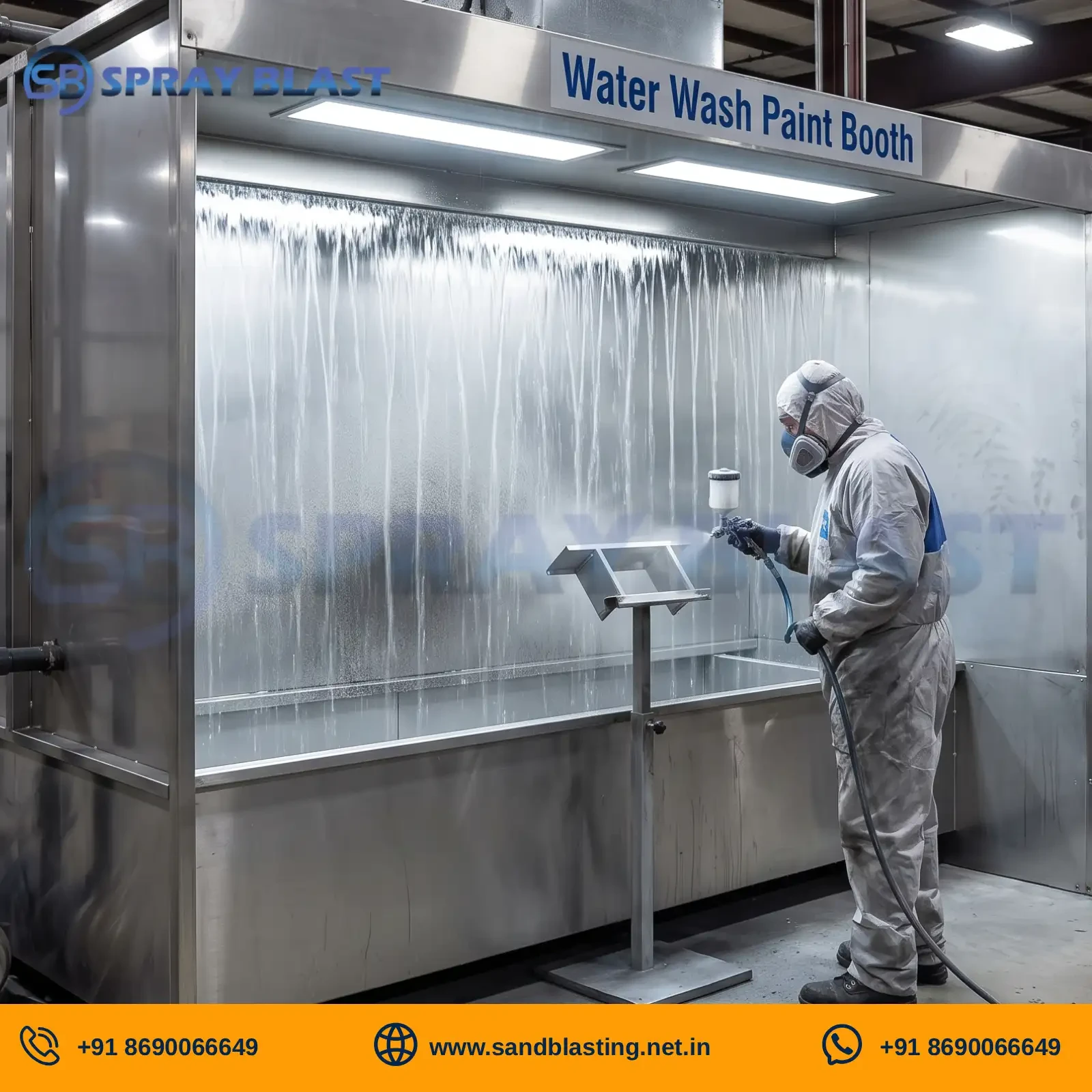
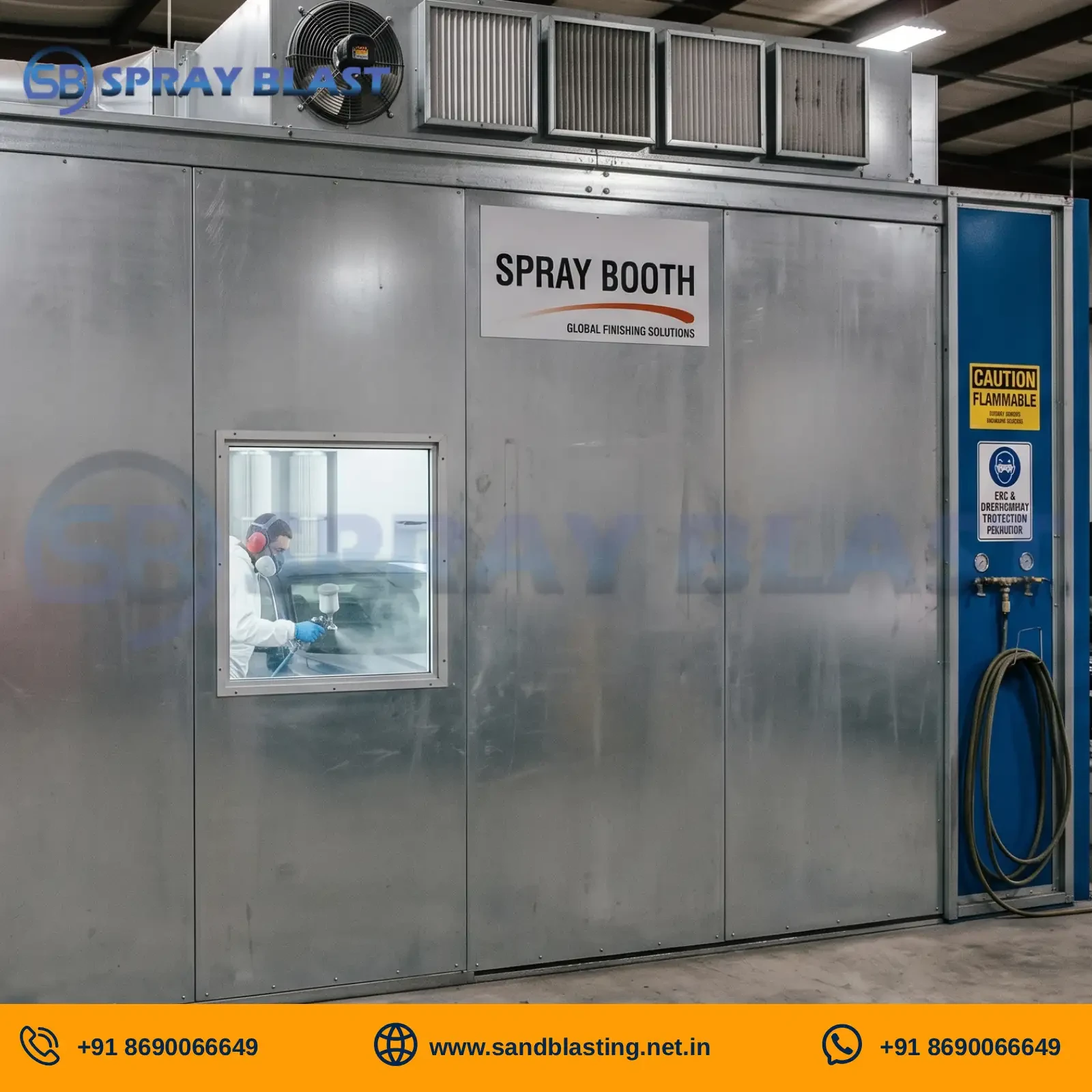
Compare Robotic Automated Paint Booth with other models in Paint Booth.
| Specification | Water Wash Paint Booth | This model Robotic Automated Paint Booth | Enclosed Paint Booth |
|---|---|---|---|
| Airflow Capacity | 8,000 - 12,000 CFM | — | — |
| External Dimensions (W x H x D) | 10' x 8' x 8' | — | — |
| Internal Working Area (W x H x D) | 9'6" x 7'8" x 6' | — | — |
| Construction Material | 18-Gauge Mild Steel | — | 18-gauge, pre-punched, single-skin mild steel panels; white powder-coated finish (interior/exterior) |
| Water Tank Capacity | 200 Gallons (757 Liters) | — | — |
| Water Pump Motor | 2 HP TEFC Motor | — | — |
| Exhaust Fan Motor | 5 HP Tubeaxial Fan | — | — |
| Filtration Efficiency | >99% particulate overspray capture | — | — |
| Lighting | 4 x T8 LED Fixtures (Class I, Div 2) | LED Flameproof Lighting (800–1000 Lux) | Class 1, Division 2 explosion-proof LED light fixtures; 100-150 ft-candles illumination |
| Paint Compatibility | Solvent-based, Water-based, Primers, Enamels, Urethanes, Epoxies | — | — |
| Application System Compatibility | HVLP, Airless, Air-Assisted Airless, Electrostatic, Robotic Applicators | — | — |
| Control Panel | NEMA 12 Control Panel with motor starters, light switches, and airflow monitoring | — | UL/ETL listed industrial control panel with motor starters, airflow control, and digital temperature display |
| Compliance Standards | Designed to meet or exceed NFPA 33, OSHA 1910, and IFC standards | — | — |
| Country of Origin | Manufactured in India | — | Manufactured in the USA with globally sourced components |
| Brand | Spray Blast | Spray Blast | Spray Blast |
| Country | India | India | India |
| Packaging | Customized | Customized | Customized |
| Transport | Local Transport | Local Transport | Local Transport |
| Price Range | Rs 8 Lakh - 10 Cr. | Rs 8 Lakh - 10 Cr. | Rs 8 Lakh - 10 Cr. |
| Booth Type | — | Fully Automated Robotic Paint Booth | — |
| Automation Level | — | Robotic (Programmable PLC / CNC Controlled) | — |
| Robot Type | — | 4-Axis / 6-Axis Industrial Painting Robot | — |
| Working Envelope | — | Customizable (Based on component size & layout) | — |
| Payload Capacity | — | 5 – 20 kg (depending on robot model) | — |
| Repeatability | — | ±0.02 mm to ±0.1 mm | — |
| Painting System | — | Air Spray / Airless / Electrostatic Spray | — |
| No. of Spray Guns | — | 1 to 4 (Customizable) | — |
| Booth Construction | — | Powder-coated MS / Galvanized Steel Panels | — |
| Airflow Design | — | Crossdraft / Downdraft / Side Draft | — |
| Filtration System | — | Multi-stage (Pre-filter + Paint Arrestor + HEPA Optional) | 3-Stage: Pre-filter (G3), Ceiling Intake Filter (F5), Exhaust Filter (Fiberglass Paint Arrestor) |
| Air Velocity | — | 0.3 – 0.5 m/s (adjustable) | — |
| Control System | — | PLC + HMI Touch Panel | — |
| Programming | — | Teach Pendant / Offline Programming | — |
| Conveyor System | — | Overhead / Roller / Power & Free Conveyor (Optional) | — |
| Drying System | — | Integrated Baking Oven / IR Heater (Optional) | — |
| Dust Collection | — | Wet Scrubber / Dry Type Dust Collector | — |
| Power Supply | — | 380V – 440V, 3 Phase, 50 Hz | — |
| Safety Features | — | Emergency Stop, Interlocks, Flameproof Panels, Fire Suppression System | — |
| Model Series | — | — | EPB-2000 (Standard), EPB-3000 (Pressurized), EPB-4000 (Climate-Controlled) |
| External Dimensions (L x W x H) | — | — | Standard sizes range from 24' x 14' x 9' to 40' x 16' x 12'; custom sizes available |
| Internal Working Dimensions (L x W x H) | — | — | Standard sizes range from 23'6" x 13'6" x 8'6" to 39'6" x 15'6" x 11'6" |
| Airflow System | — | — | Downdraft, Semi-Downdraft, or Crossdraft configurations; 12,000 - 28,000 CFM (Cubic Feet per Minute) |
| Power Requirements | — | — | 208V/230V/460V, 3-Phase, 60Hz; specific requirements vary by model and options |
| Heating & Curing System | — | — | Optional: Direct-fired natural gas or propane air makeup unit (AMU) for pressurized and climate-controlled models |
| Personnel & Vehicle Doors | — | — | Tri-fold main doors with observation windows; one personnel door with observation window and panic latch |
| Compliance | — | — | Designed to meet or exceed NFPA 33, OSHA, and IFC standards |
| Compatibility | — | — | Suitable for solvent-based and waterborne coatings, primers, and clear coats |
Typical applications for Robotic Automated Paint Booth across industrial blasting, coating, and surface preparation work.
Robotic Automated Paint Booth provides a contained zone for primer and finish coats.
EnquireFilters or a water curtain capture paint solids from the airstream.
EnquireFabrications, vehicles, or components are coated under controlled lighting.
EnquireCoated work flashes or bakes according to the booth setup.
EnquireFirst coats are sprayed with stable airflow and clean filters.
EnquireOld equipment is refinished inside a contained spray envelope.
EnquireBooth lighting supports consistent color checks during spray.
EnquireEnclosed airflow helps meet site rules for solvent coatings.
EnquireAnswer a few questions and we will suggest a starting configuration for Robotic Automated Paint Booth — then confirm the exact specification with our team.
What will you paint or coat?
Coating process?
Preferred airflow style?
Heating requirement?
Installation type?
Clear answers on specification, usage, and what to expect before you request a quote.
Tell us the application, quantity, and delivery need for Robotic Automated Paint Booth.
Tell us the product, application, quantity, or repeat supply requirement for steel shot, steel grit, garnet abrasive, glass beads, or related blasting media.