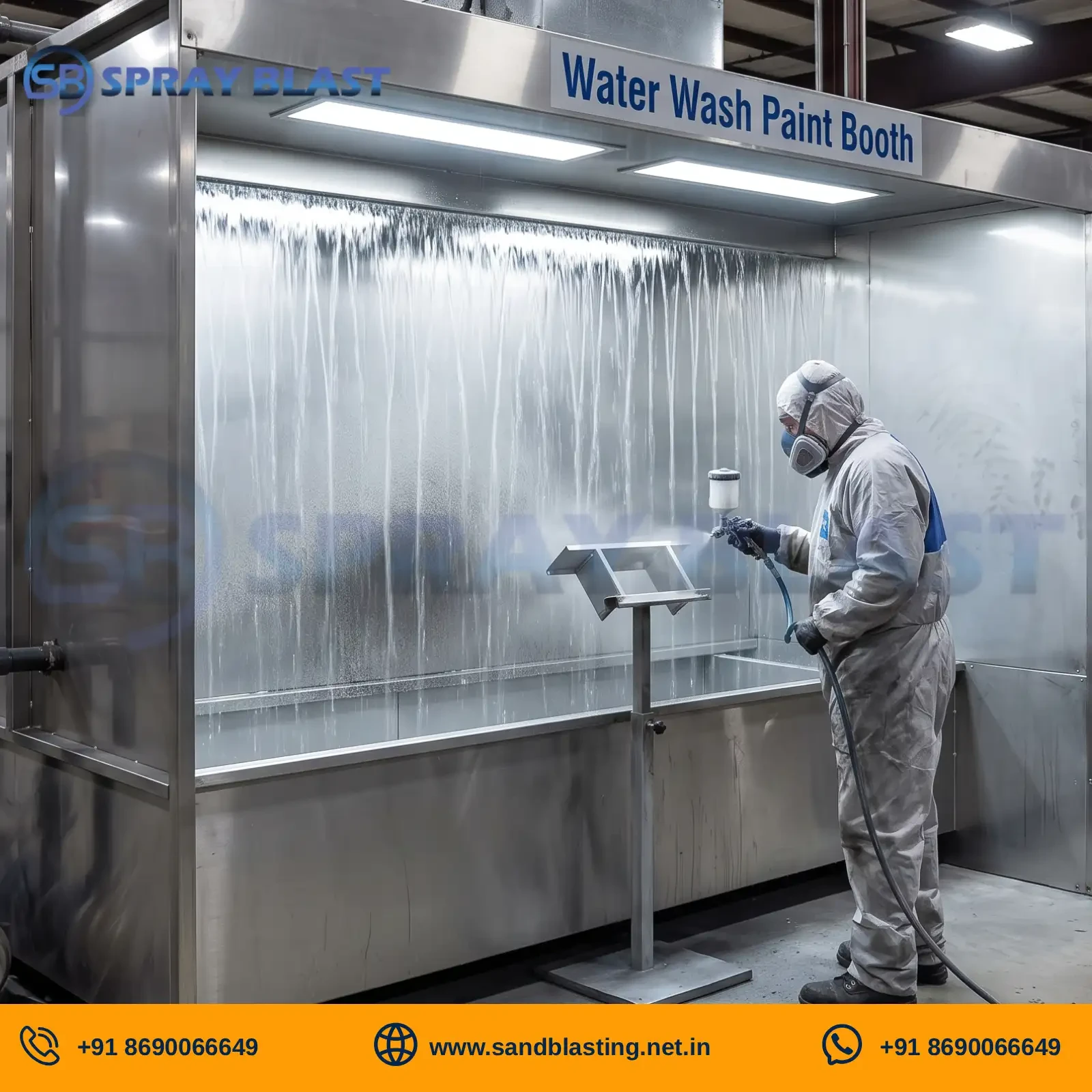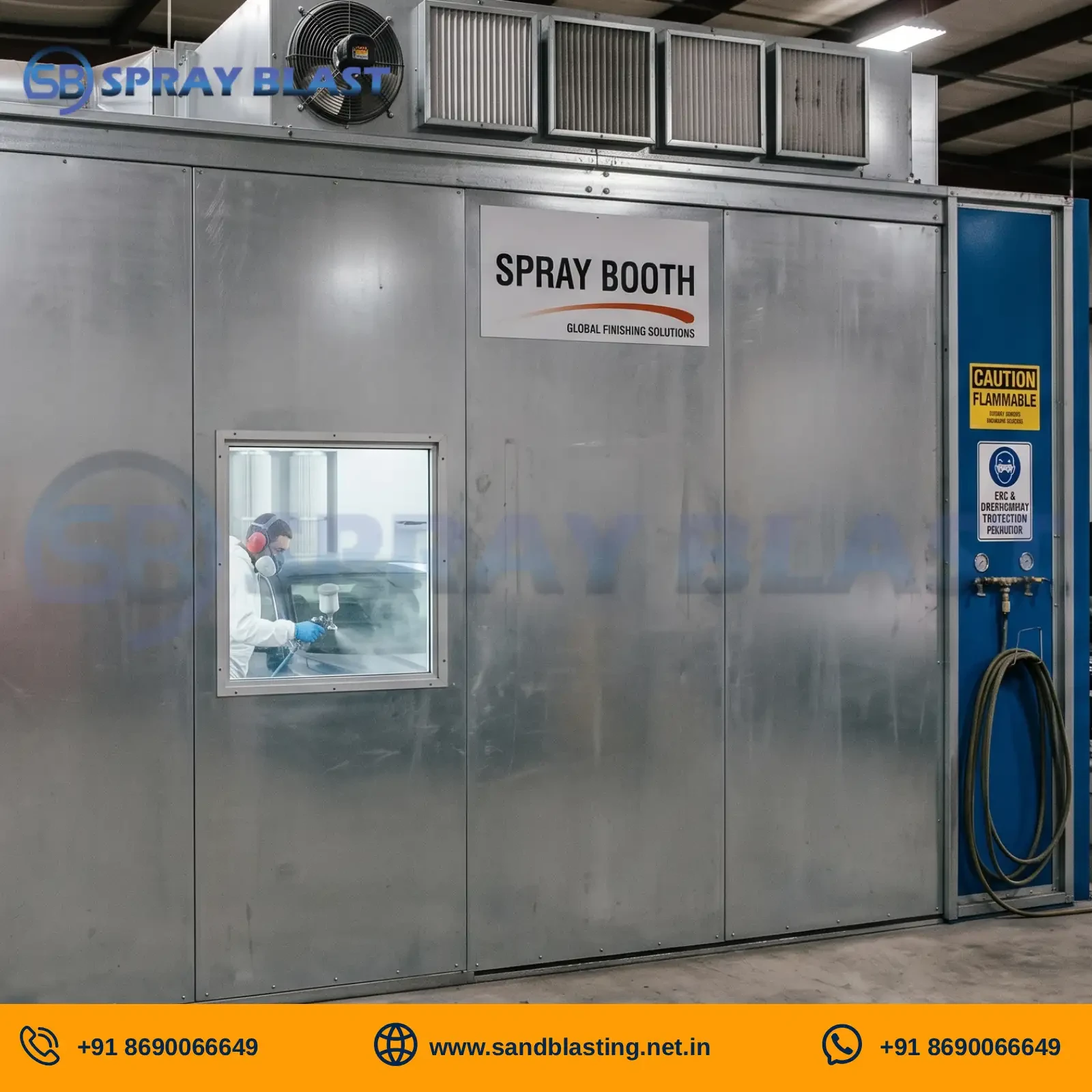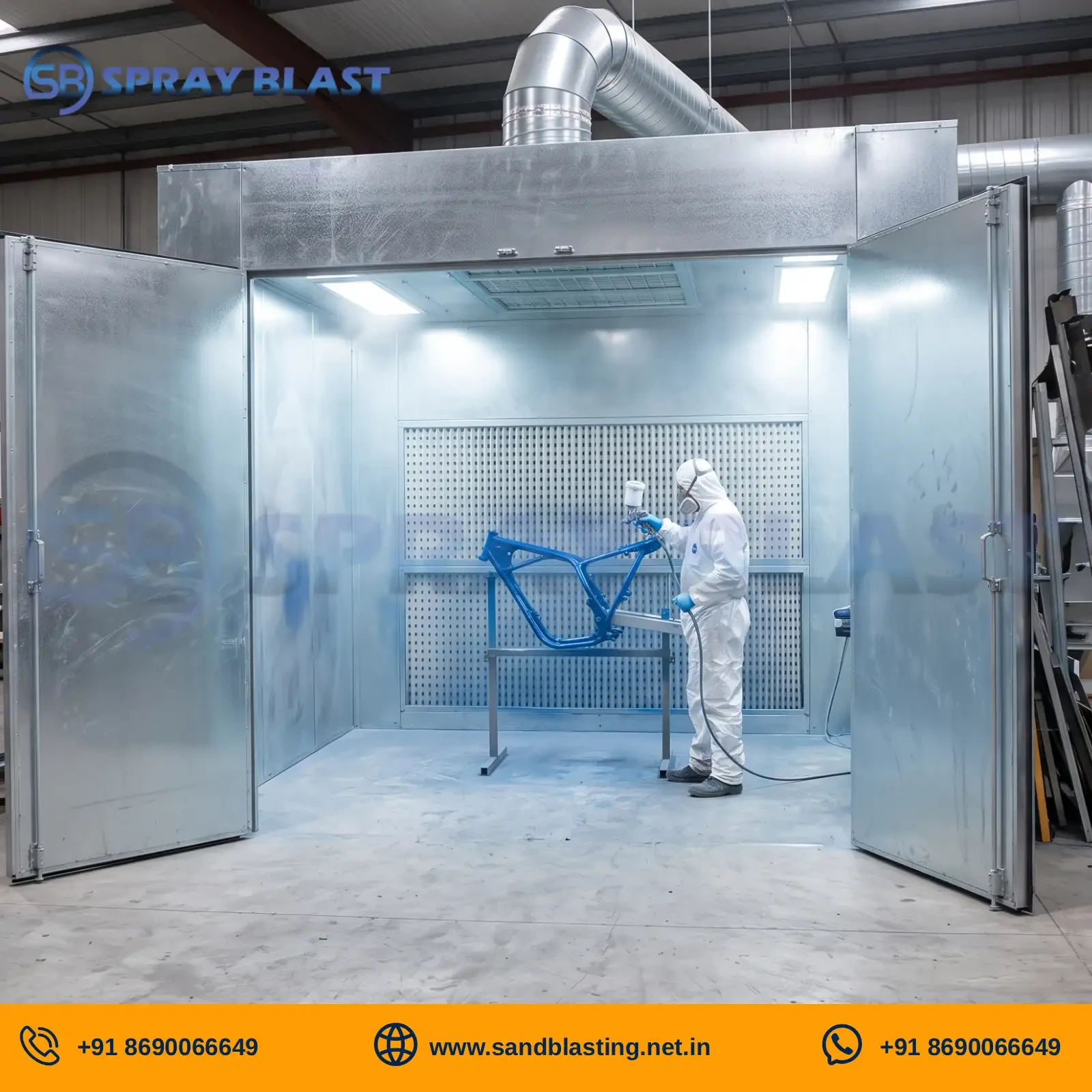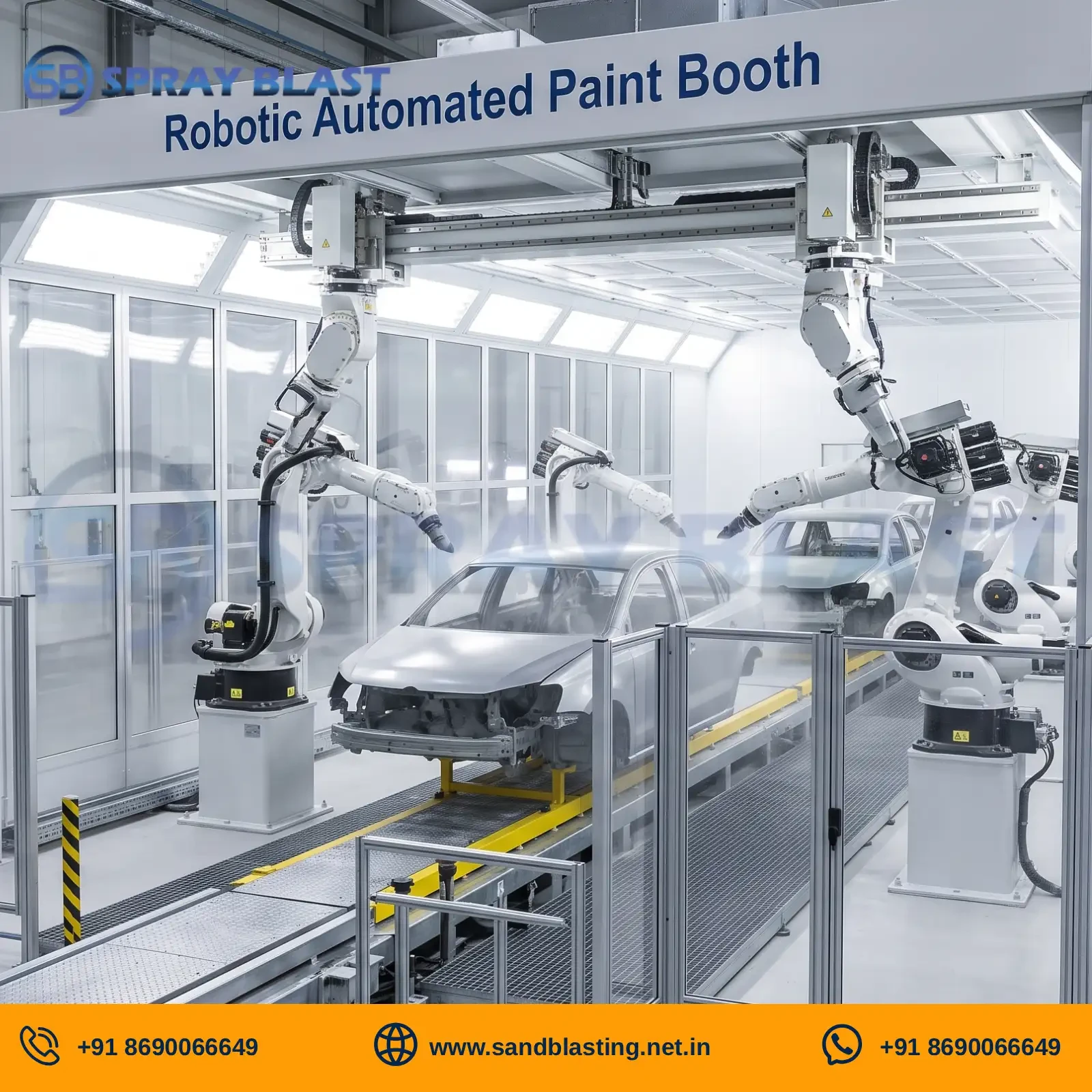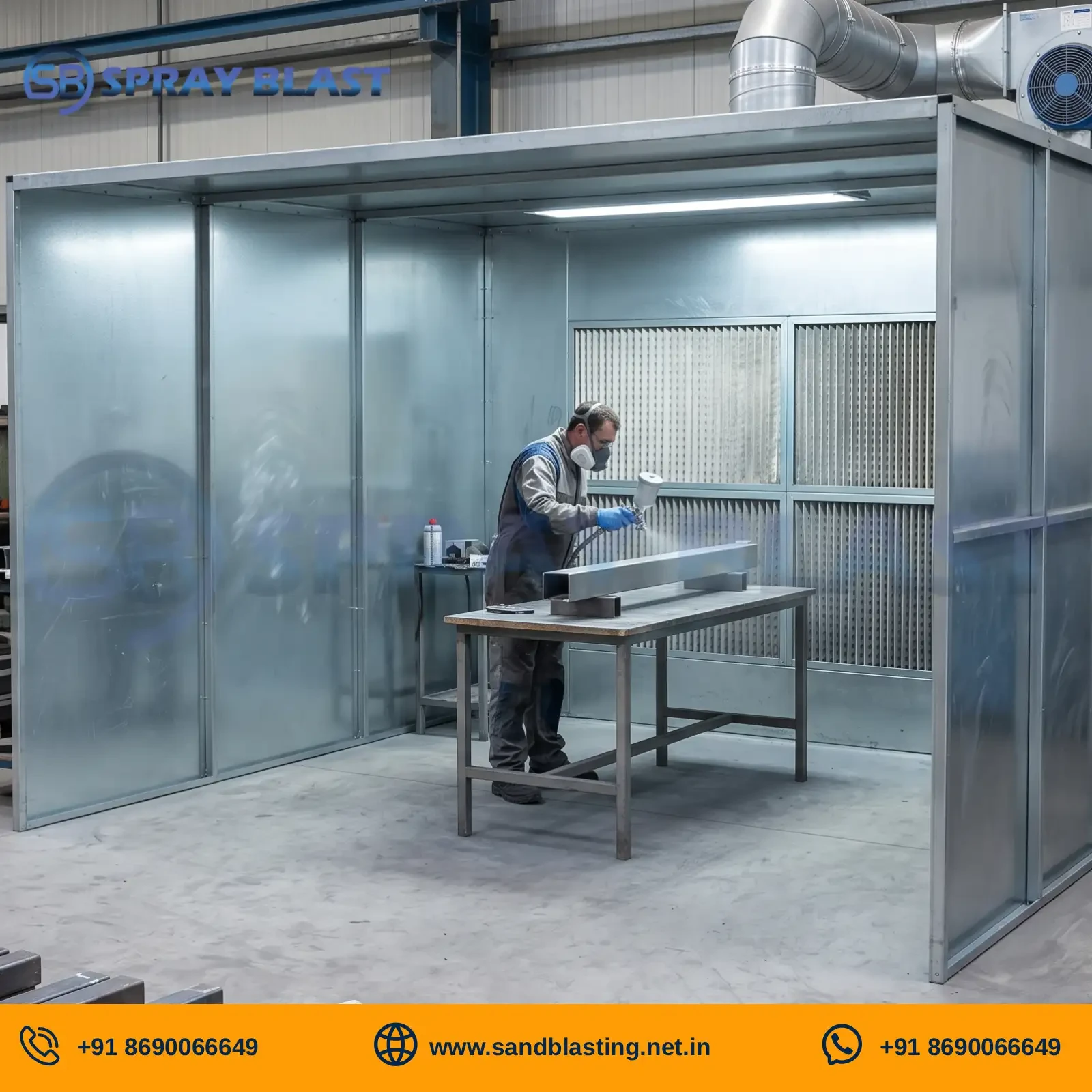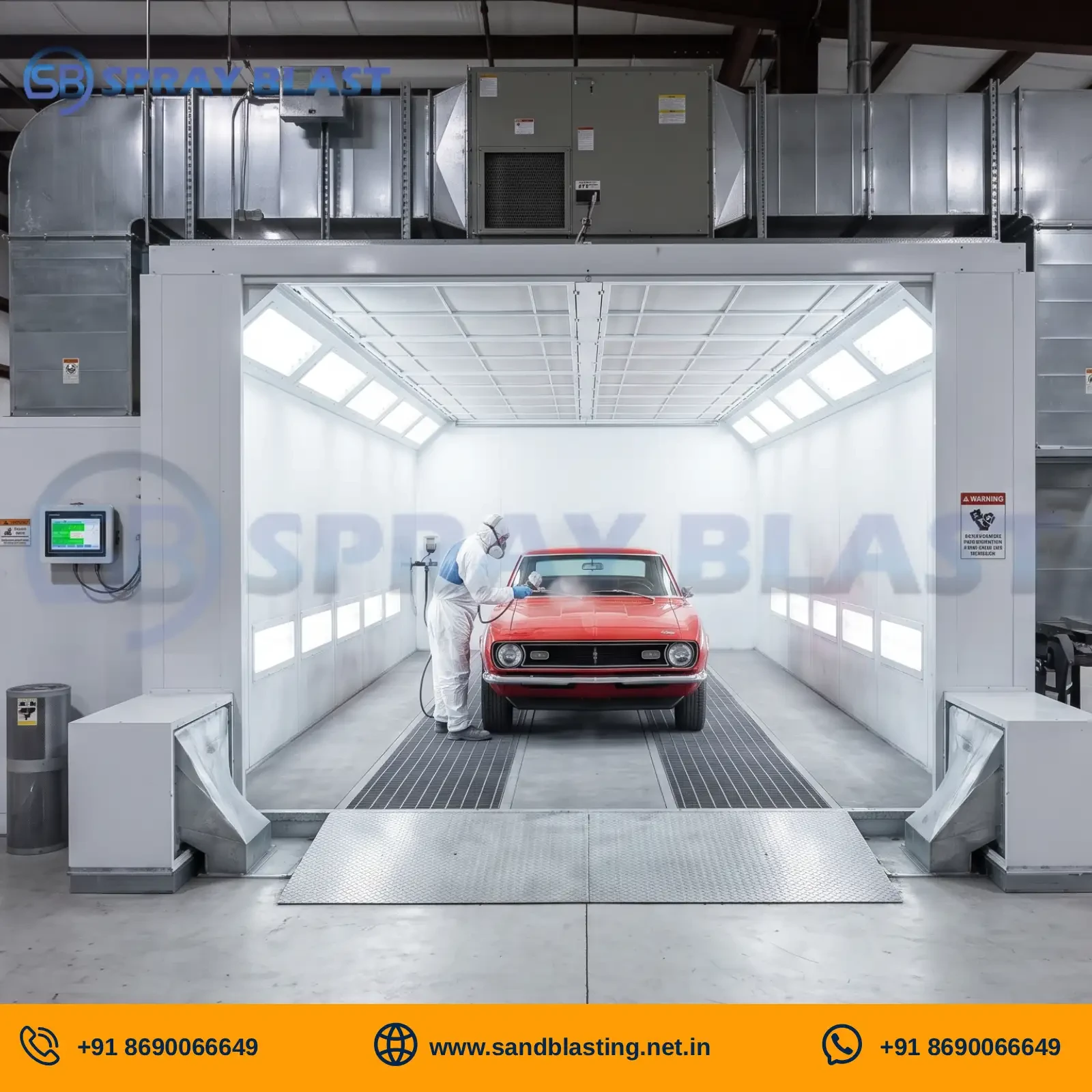
Spray Painting
Semi Downdraft Paint Booth provides a contained zone for primer and finish coats.
EnquirePaint Booth
Explore our semi-downdraft paint booths, engineered for a high-quality finish. This versatile, mid-range solution offers hybrid airflow for efficient overspray control. Ideal for industrial applications. Get a quote.
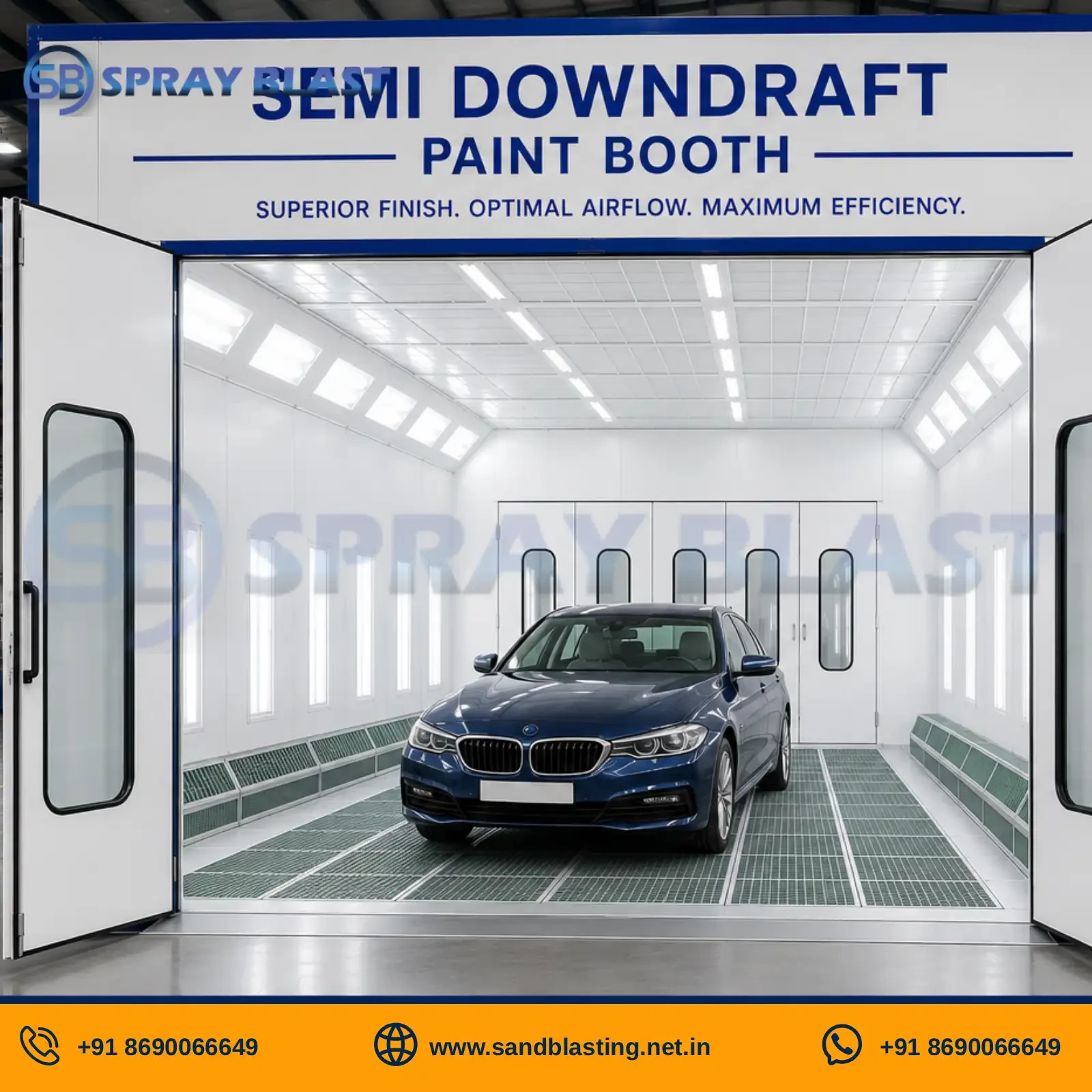
Review the key product specifications used for quotation and application planning.
Explore our semi-downdraft paint booths, engineered for a high-quality finish. This versatile, mid-range solution offers hybrid airflow for efficient overspray control. Ideal for industrial applications. Get a quote.
The job is centered in Semi Downdraft Paint Booth under the ceiling intake.
Filtered air enters from the ceiling and travels toward rear exhaust.
Painters work with a diagonal airflow that carries overspray off the finish.
Rear filters capture paint solids while lighting keeps color matching accurate.
Optional heat and pressure settings stabilize spray and flash times.
Finished work exits and filters are checked before the next cycle.
A semi-downdraft paint booth is a very good choice if one wants the benefits of a full downdraft booth, and at the same time, the cost of a crossdraft booth. As a multi-purpose booth, its main advantage is giving the customer a finished product almost at the level of a downdraft booth without having the expense of a concrete pit, which is a requirement of this type of booth. With this type of booth, fresh, clean, and filtered air comes into the booth through the ceiling at the front, then diagonally across the object being sprayed, and finally comes out at the back of the booth. This semi-downdraft type of air circulation greatly minimizes the amount of airborne contaminants and paint overspray, thus creating a clean environment with better results for different industrial applications of this booth.
The semi-downdraft booth is made of heavy-duty, galvanized steel with factory-standard components of industrial-grade quality, thus giving it a high level of solidity and capability of high-performance results over a long period of use. It has been engineered with maximum efficiency in mind, thus giving it features like a consistent airflow plan, temperature control, and a very effective overspray capture, thus reducing the overall costs of operation and production cycles. Any business looking forward to improving the quality of its finishing work and, at the same time, speeding up production without having to shell out the price of a full downdraft booth will find this booth a valuable payback investment, thus giving the business benefits like improved efficiency, regulatory compliance, and perfection every time.
This table provides the detailed engineering and performance data for our semi-downdraft paint booth models. All parts are chosen for their longevity, regulatory compliance, and most suitable finishing performance in tough industrial settings.
| Feature | Specification |
|---|---|
| Product Model | SDS Series (e.g., SDS-1428, SDS-1632) |
| Booth Type | Semi-Downdraft Paint Booth / Hybrid Airflow Design |
| Construction Material | Precision-punched, 18-gauge mild steel wall and roof panels. White powder-coated finish available as an option. |
| Standard Dimensions (Internal) | Width: 14' - 18' Height: 9' - 16' Length: 24' - 50' Custom dimensions are available upon request. |
| Airflow Capacity | 12,000 - 28,000 CFM (Cubic Feet per Minute), configured based on booth dimensions and application requirements. |
| Ventilation System | Intake: Ceiling-mounted, filtered plenum for clean air introduction. Exhaust: Rear wall exhaust chamber with high-efficiency paint arrestors. |
| Filtration | Intake: 99% efficient, Class 2 intake filters. Exhaust: Multi-stage system with 99% efficient, Class 2 paint arrestor filters. |
| Lighting | High-efficiency, 4-tube T8 fluorescent light fixtures. Class I, Division 2 rated with clear, tempered safety glass. |
| Control Panel | ETL-listed NEMA 12 industrial control panel including motor starters, airflow controls, lighting switches, and emergency stop. |
| Exhaust Fan & Motor | High-static, non-sparking, tube-axial exhaust fan with a TEFC (Totally Enclosed, Fan-Cooled) 3-phase motor (5 - 15 HP, model dependent). |
| Main Doors | Bi-fold or tri-fold filtered product doors with integrated observation windows. Standard size: 10' W x 9' H. |
| Personnel Door | One (1) 3' W x 7' H personnel access door with an observation window and panic latch. |
| Compatibility | Engineered for use with a wide range of solvent-based and waterborne industrial coatings. |
| Country of Origin | Engineered and Manufactured in the USA. |
A semi-downdraft paint booth is created by utilizing a put hybrid airflow principle, which is a mix of a crossdraft paint booth’s efficiency and a key feature of a superior contamination control of a downdraft paint booth. And then, an industrial paint booth would be able to utilize this mode of operation, which would create a cleaner working environment with control, and this is the best way if you want to have a high-quality finish for your industrial or automotive finishing. The mechanism would be concerned with the paint mist that would be directed in the opposite direction of the operator and product, so it would be harmless, and the quality would be improved.
The entire process is just a few steps:
Our semi-downdraft paint booth is designed using top-grade industrial components that are selected on the basis of their quality, safety, and performance. Each component is specifically designed to offer the best finishing environment. The following table shows the major components included in our standard paint booth.
| Component Name | Description | Function | Material | Dimensions (Typical) | Weight (Approx.) |
|---|---|---|---|---|---|
| Cabin Panels | Interlocking, dual-wall insulated panels form the booth's main structure. | Creates a sealed, controlled environment for finishing and contains hazardous vapors. | 18-gauge mild Steel with Rockwool Insulation | 24" W x 120" H x 2" D (per panel) | 75 lbs (34 kg) per panel |
| Air Intake Plenum | A filtered chamber is integrated into the front ceiling of the booth. | Distributes clean, filtered air evenly to initiate the semi-downdraft airflow pattern. | 20-gauge mild Steel | Matches booth width x 48" D x 24" H | 250 lbs (113 kg) |
| Rear Exhaust Plenum | A filtered chamber is built into the lower section of the rear wall. | Draws air and overspray away from the workpiece towards the exhaust stack. | 18-gauge mild Steel with Filter Frames | Matches booth width x 48" H | 400 lbs (181 kg) |
| Air Makeup Unit (AMU) | Direct-fired heating and ventilation unit connected to the intake plenum. | Heats, pressurizes, and filters incoming air for optimal spray and cure cycles. | Heavy-gauge Aluminized Steel Casing, Stainless Steel Burner | 120" L x 60" W x 60" H | 1,500 lbs (680 kg) |
| UL-Listed Control Panel | Centralized electrical system with motor starters, cycle selectors, and digital controls. | Provides the operator with full control over all semi-downdraft paint booth functions. | NEMA 12 Steel Enclosure | 24" W x 30" H x 10" D | 80 lbs (36 kg) |
| Lighting Fixtures | Class I, Div. 2 high-efficiency, 4-tube LED or fluorescent light fixtures. | Delivers bright, color-corrected, and safe illumination in a hazardous location. | Steel Housing, Tempered Glass Lens | 48" L x 14" W x 4" D | 35 lbs (16 kg) per fixture |
| Tube-Axial Exhaust Fan | High-volume, non-sparking fan with a TEFC (Totally Enclosed, Fan-Cooled) motor. | Powers the ventilation by pulling contaminated air through the exhaust filtration system. | Aluminum Fan Blades, Steel Housing | 34" Diameter Fan, 5-10 HP Motor | 350 lbs (159 kg) |
| Filtration Media | Multi-stage system: ceiling intake prefilter and rear wall exhaust paint arrestor. | Intake filters clean incoming air; exhaust filters capture >99% of paint overspray. | Synthetic Fiber (Intake), Multi-layer Fiberglass (Exhaust) | 20" x 20" Pads or Bulk Rolls | Varies by quantity |
| Main Product Doors | Bi-fold or tri-fold filtered doors provide full-width access to the booth. | Allows for easy movement of large workpieces into and out of the booth. | 18-gauge mild Steel with Viewing Windows | Sized to booth opening (e.g., 12' W x 10' H) | 600 lbs (272 kg) per set |
| Personnel Access Door | A single, heavy-duty door with a viewing window and panic hardware. | Provides safe and convenient entry and exit for operators without opening the main doors. | 18-gauge mild Steel | 36" W x 84" H | 150 lbs (68 kg) |
Semi-Downdraft Paint Booth is not just a device; it is a strategic tool created to meet the stringent demands of modern-day industrial finishing operations. The device is a direct response to the primary concerns faced by procurement managers, compliance officers, and supervisors in high-pressure industries.
For a procurement team, a semi-downdraft paint booth is an ideal balance between capital outlay and operational value. It is a step up in performance from a crossdraft paint booth, yet it doesn't require all the infrastructure and expense of a downdraft paint booth.
Stringent regulatory requirements have to be met. Our semi-downdraft paint booths are designed to make it easier to comply with key national and international regulatory requirements, including those from OSHA, NFPA, and EPA. The semi-downdraft ventilation system is essential for a safe work environment and for environmental responsibility.
Any break in operations in industrial finishing would lead to a loss of revenue. The stability of a semi-downdraft paint booth is a key factor in keeping the production plans intact and delivering the goods by the agreed-upon times. We focus our efforts on ensuring a strong frame and use of top-grade materials in order to provide great, reliable performance over time.
In some sectors, the appearance of the final product is a major quality factor—examples include the aerospace industry, car body repair, and luxury cabinetry—in those areas, accuracy is the main thing. The semi-downdraft air movement at the booth is aimed at achieving a top-notch, flaw-free finish.
One of the major decisions that you need to make is where to invest in capital equipment. This is because it is the foundation of your operational success. If you want top results from your procurement process, then go for a semi- downdraft paint booth that will best meet your technical and commercial requirements. You might want to verify the following features to see if they measure up to your requirements:
Verify Airflow Performance and Compliance: Confirm before purchase that the airflow velocity of the booth, usually 100 FPM at the operator's level, is sufficient for your finishing requirements yet safe and compliant with standards. Ask the seller to provide evidence of compliance with NFPA 33, OSHA, and electrical component safety certifications such as CE or UL/ETL. This is a very important factor for operator safety and regulatory approval.
Evaluate Total Cost of Ownership (TCO): Don't be fooled by the initial price only. A more cost-effective semi-downdraft paint booth means a good asset that will achieve a high level of power combined with operational efficiency. Ask about the energy usage of motors and lighting (also ask if LED versions are available), the normal life span, the cost of replacement of filters (intake and exhaust), and the recommended maintenance schedule.
Customization, Integration: It might be that the same old sizes do not correspond to your way of working or the size of your facility. Tell the seller about your custom dimension needs, drive-through door configurations, personnel doors, and conveyor systems or production lines. The manufacturer of high-grade equipment is able to offer detailed CAD drawings for customer approval before implementation.
MOQ & Supply: We handle any project size. One unit minimum order (MOQ) is available for solo workshops or facility upgrades. For large-scale projects like setting up new plants or multiple locations, check with us about our bulk supply capabilities, which might include phased delivery schedules and volume-based pricing.
International Shipping and Export Readiness: If you are a global customer, then export knowledge verification is a must. Make sure that the vendor supplies strong crating (compliant with ISPM 15), does all the necessary export paperwork, and can set up the semi- downdraft paint booth for your region's specific voltage and frequency requirements (e.g., 380V/50Hz, 415V/50Hz).
Technical Proposal: Have the formal proposal/documents handy. A proposal that has only prices but no details of the materials, technical specifications for the cabin, air handling unit (AHU), control panel, and schedule, covering fabrication, shipment, and installation time, is not good.
Warranty, Spares, After-Sales Support: A good warranty is a sign of high manufacturing quality. Ask for warranty conditions for the booth structure, fans, motors, and control systems. Also, check that there is an ordered process for replacement filters and spare parts to have little or no downtime. Also, check if installation supervision and operator training are offered.
Selecting the optimal paint booth involves balancing cost, performance, and operational requirements. The semi-downdraft paint booth occupies a strategic middle ground, offering significant advantages over entry-level systems without the full investment of a premium downdraft booth. This table compares the three primary airflow configurations to help you make an informed decision.
| Feature | Crossdraft Paint Booth | Semi-Downdraft Paint Booth | Downdraft Paint Booth |
|---|---|---|---|
| Price Point | Most Economical | Balanced Investment | Highest Initial Cost |
| Performance | Good: Air flows horizontally from the intake doors to the rear exhaust wall. Effective for industrial coatings, but can pull overspray and contaminants across the length of the workpiece. | Better: The hybrid airflow draws clean, filtered air from the ceiling at the front and exhausts it at the floor level in the rear. This semi-downdraft ventilation significantly reduces contamination for a cleaner finish. | Best: Air flows vertically from a full ceiling plenum to a filtered exhaust pit in the floor. This provides the most effective overspray and contaminant removal, delivering a near-flawless, Class-A finish. |
| Features | Basic design with simple intake/exhaust filtration. Easiest to install and maintain. | Pitless design eliminates the need for costly concrete work. Features enhanced ceiling intake filtration and often includes superior lighting and optional heat/cure cycles. | Requires a concrete exhaust pit or a raised steel basement. Features a full ceiling filter bank (plenum), advanced control systems, and typically includes integrated heat and cure cycles as standard. |
| Durability | Robust and simple construction with fewer mechanical components, leading to straightforward long-term maintenance. | Engineered for industrial use with durable paneling and fan/motor assemblies. The design balances complexity and reliability for a long service life with standard maintenance protocols. | Most complex system with underfloor plenums and filtration that requires diligent maintenance to ensure peak performance and longevity. Construction is typically heavy-duty to support high-volume production. |
| Target Users | Operations focused on budget and function over finish quality, such as large equipment manufacturing, primer coating, and entry-level fabrication shops. | Automotive collision repair, custom woodworking, and industrial finishers who require a high-quality finish without the cost and facility modifications of a full downdraft system. The versatile paint booth for growing businesses. | High-volume automotive refinishing centers, aerospace MRO facilities, and premium manufacturers where a flawless, contaminant-free finish is non-negotiable. |
Compare Semi Downdraft Paint Booth with other models in Paint Booth.
| Specification | Water Wash Paint Booth | This model Semi Downdraft Paint Booth | Enclosed Paint Booth |
|---|---|---|---|
| Airflow Capacity | 8,000 - 12,000 CFM | 12,000 - 28,000 CFM, configured based on booth dimensions and application requirements. | — |
| External Dimensions (W x H x D) | 10' x 8' x 8' | — | — |
| Internal Working Area (W x H x D) | 9'6" x 7'8" x 6' | — | — |
| Construction Material | 18-Gauge Mild Steel | Precision-punched, 18-gauge mild steel wall and roof panels. White powder-coated finish available as an option. | 18-gauge, pre-punched, single-skin mild steel panels; white powder-coated finish (interior/exterior) |
| Water Tank Capacity | 200 Gallons (757 Liters) | — | — |
| Water Pump Motor | 2 HP TEFC Motor | — | — |
| Exhaust Fan Motor | 5 HP Tubeaxial Fan | — | — |
| Filtration Efficiency | >99% particulate overspray capture | — | — |
| Lighting | 4 x T8 LED Fixtures (Class I, Div 2) | High-efficiency, 4-tube T8 fluorescent light fixtures. Class I, Division 2 rated with clear, tempered safety glass. | Class 1, Division 2 explosion-proof LED light fixtures; 100-150 ft-candles illumination |
| Paint Compatibility | Solvent-based, Water-based, Primers, Enamels, Urethanes, Epoxies | — | — |
| Application System Compatibility | HVLP, Airless, Air-Assisted Airless, Electrostatic, Robotic Applicators | — | — |
| Control Panel | NEMA 12 Control Panel with motor starters, light switches, and airflow monitoring | ETL-listed NEMA 12 industrial control panel including motor starters, airflow controls, lighting switches, and emergency stop. | UL/ETL listed industrial control panel with motor starters, airflow control, and digital temperature display |
| Compliance Standards | Designed to meet or exceed NFPA 33, OSHA 1910, and IFC standards | — | — |
| Country of Origin | Manufactured in India | India | Manufactured in the USA with globally sourced components |
| Brand | Spray Blast | Spray Blast | Spray Blast |
| Country | India | India | India |
| Packaging | Customized | Customized | Customized |
| Transport | Local Transport | Local Transport | Local Transport |
| Price Range | Rs 8 Lakh - 10 Cr. | Rs 8 Lakh - 10 Cr. | Rs 8 Lakh - 10 Cr. |
| Feature | — | Specification | — |
| Product Model | — | SDS Series (e.g., SDS-1428, SDS-1632) | — |
| Booth Type | — | Semi-Downdraft Paint Booth / Hybrid Airflow Design | — |
| Standard Dimensions (Internal) | — | Width: 14' - 18' Height: 9' - 16' Length: 24' - 50' (Custom dimensions are available upon request.) | — |
| Ventilation System | — | Intake: Ceiling-mounted, filtered plenum for clean air introduction. Exhaust: Rear wall exhaust chamber with high-efficiency paint arrestors. | — |
| Filtration | — | Intake: 99% efficient, Class 2 intake filters. Exhaust: Multi-stage system with 99% efficient, Class 2 paint arrestor filters. | — |
| Exhaust Fan & Motor | — | High-static, non-sparking, tube-axial exhaust fan with a TEFC (Totally Enclosed, Fan-Cooled) 3-phase motor (5 - 15 HP, model dependent). | — |
| Main Doors | — | Bi-fold or tri-fold filtered product doors with integrated observation windows. Standard size: 10' W x 9' H. | — |
| Personnel Door | — | One (1) 3' W x 7' H personnel access door with an observation window and panic latch. | — |
| Compatibility | — | Engineered for use with a wide range of solvent-based and waterborne industrial coatings. | Suitable for solvent-based and waterborne coatings, primers, and clear coats |
| Model Series | — | — | EPB-2000 (Standard), EPB-3000 (Pressurized), EPB-4000 (Climate-Controlled) |
| External Dimensions (L x W x H) | — | — | Standard sizes range from 24' x 14' x 9' to 40' x 16' x 12'; custom sizes available |
| Internal Working Dimensions (L x W x H) | — | — | Standard sizes range from 23'6" x 13'6" x 8'6" to 39'6" x 15'6" x 11'6" |
| Airflow System | — | — | Downdraft, Semi-Downdraft, or Crossdraft configurations; 12,000 - 28,000 CFM (Cubic Feet per Minute) |
| Filtration System | — | — | 3-Stage: Pre-filter (G3), Ceiling Intake Filter (F5), Exhaust Filter (Fiberglass Paint Arrestor) |
| Power Requirements | — | — | 208V/230V/460V, 3-Phase, 60Hz; specific requirements vary by model and options |
| Heating & Curing System | — | — | Optional: Direct-fired natural gas or propane air makeup unit (AMU) for pressurized and climate-controlled models |
| Personnel & Vehicle Doors | — | — | Tri-fold main doors with observation windows; one personnel door with observation window and panic latch |
| Compliance | — | — | Designed to meet or exceed NFPA 33, OSHA, and IFC standards |
Typical applications for Semi Downdraft Paint Booth across industrial blasting, coating, and surface preparation work.
Semi Downdraft Paint Booth provides a contained zone for primer and finish coats.
EnquireFilters or a water curtain capture paint solids from the airstream.
EnquireFabrications, vehicles, or components are coated under controlled lighting.
EnquireCoated work flashes or bakes according to the booth setup.
EnquireFirst coats are sprayed with stable airflow and clean filters.
EnquireOld equipment is refinished inside a contained spray envelope.
EnquireBooth lighting supports consistent color checks during spray.
EnquireEnclosed airflow helps meet site rules for solvent coatings.
EnquireAnswer a few questions and we will suggest a starting configuration for Semi Downdraft Paint Booth — then confirm the exact specification with our team.
What will you paint or coat?
Coating process?
Preferred airflow style?
Heating requirement?
Installation type?
Clear answers on specification, usage, and what to expect before you request a quote.
Tell us the application, quantity, and delivery need for Semi Downdraft Paint Booth.
Tell us the product, application, quantity, or repeat supply requirement for steel shot, steel grit, garnet abrasive, glass beads, or related blasting media.